





If you’ve ever stood in the dish aisle (or stared at your cabinets full of random plates) trying to figure out if your “soup plate” is actually the right size for ladling in stew, noodle soups, or even that chunky chili that’s too messy for a regular dinner plate—you’re not alone. As a porcelain soup plate supplier, I get questions about this all the time, and honestly? It’s way more complicated than “it holds soup.” A lot of folks mix up soup plates, shallow bowls, and dinner plates, or assume size is just a guess. But here’s the thing: size matters. Too small, and you’re spilling broth all over the table before you even finish your first bite. Too big, and your soup gets cold fast (plus you’re wasting cabinet space).
Let’s break this down, no fancy jargon, just real info from the people who make these plates and the folks who use them every single day.
First, let’s get the basics straight. When I say “porcelain soup plate,” I’m talking about that middle ground between a flat dinner plate and a deep soup bowl. It’s not super deep, but it has a slightly curved lip (or rim) to keep liquids from sloshing out—hence why it’s not just a plain plate. Now, size here is measured in inches (we stick to that in the US, and most of our international suppliers use inches too) for diameter, and sometimes by depth, but diameter is the number everyone actually cares about when grabbing one from the cupboard.
Wait, but why does size vary so much? If you hop online and start looking at porcelain soup plate options, you’ll see numbers from 8 inches all the way up to 12 inches. That’s a huge gap, right? Let’s talk about who uses what. For regular home cooks, the go-to size is usually between 9 and 10.5 inches. If you’re making small portions (like a quick bowl of miso or tomato soup), an 8-inch works great—it’s compact, easy to store, and fits in standard dishwashers. But if you’re loading up on chunky vegetable soup, stew, or even a big bowl of pho (which has lots of noodles and broth), you’ll want something bigger—10 to 11 inches. Those give you enough space so your solids don’t get lost at the bottom and your broth doesn’t spill when you pick it up.
Commercial use is totally different, though. Restaurants, cafes, and caterers need consistency. Most commercial porcelain soup plates are around 10.5 to 12 inches. Why? Because they’re designed to serve larger portions, and they have to hold up to repeated washing in industrial dishwashers. Plus, a bigger plate feels more generous to a customer—no one wants to pay for a tiny bowl of soup when they’re hungry. I’ve heard from a few small diners that they switched from 10-inch to 11-inch plates and saw fewer complaints about “not enough soup,” which makes total sense.
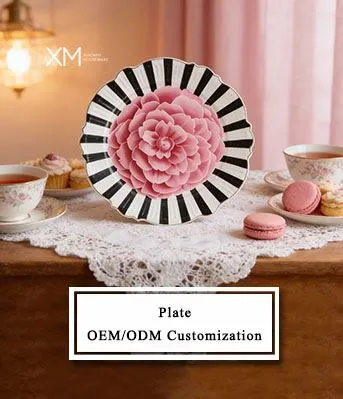
But here’s a common mistake people make: confusing soup plates with other types of porcelain plates. You might see a white porcelain plate that looks like a soup plate but is actually a shallow bowl, or a Floral Porcelain Dinner Plate that’s way too flat for soup. Let’s be clear: a standard dinner plate is usually 10 to 12 inches, but it’s almost flat. A soup plate has that raised rim (usually 0.5 to 1 inch high) to catch liquids, so even if two plates have the same diameter, the soup plate will hold more liquid than a dinner plate. For example, a 10-inch dinner plate might hold a tablespoon of broth if you tilt it, but a 10-inch porcelain soup plate holds 12 to 16 ounces—perfect for a regular serving.
Wait, how do we get those volume numbers, anyway? I talked to our quality control team last week about this, because I was tired of guessing. They do a simple test: fill the plate with water until it’s level with the rim, then pour it into a measuring cup. For an 8-inch soup plate, that’s usually 8 to 12 ounces. A 10-inch is 12 to 16 ounces, and a 12-inch can hold 16 to 20 ounces. That’s a big difference! If you’re making soup for a family of four, you might want a mix: 9-inch for the kids (smaller portions, less mess) and 10-inch for the adults. If you’re hosting a dinner party, 10.5-inch porcelain soup plates are perfect—they look nice, hold enough, and are easy to pass around the table.
Is there a “standard” size everyone agrees on? Not really, which is why I get so many confused messages. Back in the day, most home soup plates were 9 inches, but as people started eating larger portions (thanks to bigger appetites and more shareable meals), manufacturers shifted to 10 inches as the new “standard.” Now, you’ll see 9 inches called “vintage” or “small serving,” 10 is “everyday,” and 11+ is “family-style or commercial.” I’ve also noticed that for things like cereal (yes, some people use soup plates for cereal!), the 8-inch is the go-to because it’s not too deep.
Another thing: material affects how the size feels. Porcelain is thinner and sturdier than regular ceramic, so a 10-inch porcelain soup plate is actually slightly lighter than a 10-inch ceramic plate, even though it’s the same diameter. That’s why a lot of people prefer porcelain—they can have a bigger plate without it feeling heavy when they pick it up. Plus, it doesn’t chip as easily, which is a win if you have kids or are using it for everyday meals.
Wait, should you consider depth when buying? Yeah, but not as much as diameter. Most porcelain soup plates are between 1 and 1.5 inches deep. If you get something deeper than 1.5 inches, that’s a soup bowl, not a soup plate. The whole point of a soup plate is that it’s flat enough to set on a table next to your bread or salad, but deep enough to hold soup without spilling. If you want something super deep, go for a bowl—no need to force a plate to do a bowl’s job.


I’ve had customers reach out saying, “I bought a porcelain soup plate online and it’s way smaller than I thought!” That’s why checking the specs is key. A lot of online listings only say “soup plate” without the diameter, so you have to look for numbers. On our site, every porcelain soup plate listing has the exact diameter and depth, so you don’t get that surprise. For example, our Porcelain Round Soup Plate is 10 inches, which is our bestseller for home use. We also have 9-inch ones for people who have smaller cabinets or prefer lighter portions.
What about for special occasions? If you’re buying plates for a wedding or holiday dinner, you might want something a bit more polished. Our White Porcelain Plate collection has 10.5-inch soup plates that are sleek and don’t have any patterns—they go with any table setting. If you want something more decorative, our Floral Porcelain Dinner Plate has matching soup plates in some patterns, but make sure to check that the diameter is right—you don’t want a decorative plate that’s too small for heavy soup.
Let’s talk about practical stuff too. If you’re washing these plates at home, make sure they fit in your dishwasher. Most standard dishwashers fit plates up to 12 inches, so any soup plate under 12 inches is fine. But if you have a compact dishwasher, stick to 9 or 10 inches. Also, if you’re stacking them for storage, diameter matters too—bigger plates take up more space, so if your cabinets are tight, 9 or 10 inches is smart.
Wait, did I miss something? Oh, right—why does this even matter? Like, does the size of a porcelain soup plate really make that big of a difference? Let me tell you, I’ve seen it. A customer last month ordered 12-inch plates for her small bistro, and she said they were too big—her tables were small, and the plates took up half the table. She swapped them for 10.5-inch, and now she has more room for bread baskets and wine glasses. Another customer, a mom of three, was using 8-inch plates for her kids’ soup and they were spilling all over their laps, so we sent her 9-inch ones and she said “no more bath time after dinner.”
So, to wrap this up, there’s no one-size-fits-all answer to “what’s the size of a porcelain soup plate.” But the general range is 8 to 12 inches, with the sweet spot for most people being 9 to 10.5 inches. Commercial places lean 10.5 to 12 inches, home cooks with small spaces or small portions go 8 to 9 inches, and if you want something in between, 10 inches is the way to go. The key is to think about how you’ll use it: are you serving family-sized portions? Do you have a compact dishwasher? Will it be for everyday or special occasions?
If you’re shopping for porcelain soup plates and want to make sure you get the right size, check out our site—we’ve got all the specs listed clearly, so you don’t have to guess. Whether you need a few for your kitchen, a set for a restaurant, or something decorative for your dining room, we’ve got options for every need. We’re always here to help if you have questions, too—just reach out, and we’ll point you to the right plate for your space and needs.
Ready to find the perfect porcelain soup plate? Browse our collection of Porcelain Soup Plate styles, including our best-selling Porcelain Round Soup Plate, sleek White Porcelain Plate sets, and decorative Floral Porcelain Dinner Plate options. Don’t settle for plates that are the wrong size—get something that works for you, and makes soup time way less stressful.
References:
- Food Service Warehouse. "Tableware Size Standards for Restaurants & Homes" (2024)
- International Porcelain Manufacturers Association. "Dimensions & Uses of Porcelain Tableware" (2023)
- Home Trends Magazine. "The Best Soup Plates for 2024: Sizes, Styles & Picks" (2024)
- Dishwasher Manufacturer Association. "Standard Plate Sizes for Residential & Commercial Dishwashers" (2023)