






Hey everyone, it’s Mia from the porcelain plate crew—you know, the folks who’ve been hooking cafes, restaurants, and home bakers with solid plates that don’t chip after a year of running dishwashers. Lately I’ve been getting so many DMs asking: “How do I tell if a porcelain plate is actually authentic? I’ve wasted money on junk that’s labeled porcelain but scratches after two uses, or feels way too light to hold.” Fair question—especially when so many sellers are slapping “porcelain” on anything that’s not disposable. I’ve been working with this stuff for 8 years, tested hundreds of plates for durability, and today I’m breaking down the real, no-BS checks you can do without needing a lab or a fancy degree.
First off, let’s get one thing straight: authentic porcelain isn’t your grandma’s chipped kitchen plate. It’s fired at way higher temps than regular ceramic, which makes it denser, more non-porous, and way less likely to stain. I see sellers calling low-fire stoneware “porcelain” all the time, so the first check is super basic: run your finger over the edge and hold it up to a light. Real porcelain is thin, but not flimsy—like, if you hold a White Porcelain Plate up to a window, you should see a faint, even glow through the edges, right? Not see-through like plastic wrap, but enough that sunlight doesn’t just get blocked. Cheap knock-offs are either super thick and chunky (like a mason jar) or so thin they bend a little when you pick ’em up—genuine porcelain stays rigid, no give. I had a customer last month who bought a set online that claimed to be porcelain; when she held it up, the edges were opaque, and when she tapped it, it sounded like a plastic cup, not that clear, ringing tone you get from solid ceramic.
That tap test is next, and it’s a game-changer. I do this every single time I unload a new shipment. Gently flick the edge with your fingernail—authentic porcelain gives a crisp, high-pitched ring, kind of like a small bell. Low-fire stuff sounds dull, like tapping a coffee mug that’s been washed a hundred times. Why does that matter? The ring tells you it’s dense and non-porous. Porosity is the big difference between “looks like porcelain” and actually being porcelain. If a plate is porous, it’ll soak up sauce, coffee, or any colored liquid after a few uses, and that stain never comes out. I used to test this by putting a drop of red food coloring on the back of plates; authentic porcelain just beads up and wipes off with a paper towel, no mark. I once got a sample from a supplier that said porcelain, and the food coloring soaked right in—total fake, and we didn’t even bother testing it further.
Wait, let’s talk about weight, too. I know I mentioned thin, but thin doesn’t mean light. A 10-inch authentic porcelain dinner plate should feel solid in your hand, not feather-light like a disposable plate or a thin melamine. A lot of cheap fakes are made with pressed powder that’s baked low, so they’re light but chip super easy. Check out our Porcelain Dinner Plate range—those are the good ones, each weighs just enough that you don’t worry about it tipping over when you load up a big steak or a pasta bowl, but not so heavy that your grandma complains about carrying it to the table. I once compared a “porcelain” plate from a department store to our dinner plate: theirs felt like holding a empty cereal bowl, ours had a nice, substantial weight that balanced well.


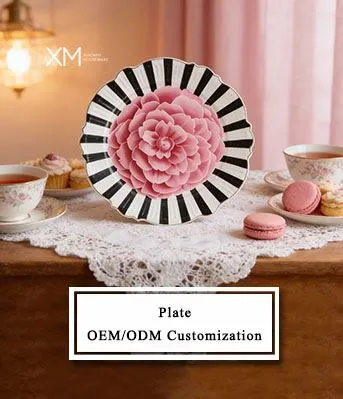
Next up, the glaze. This is where a lot of knock-offs cut corners. Authentic porcelain glaze is smooth, consistent, and has that soft, not-crazy-shiny sheen. If you run your hand over the surface, there shouldn’t be any tiny bumps, lines, or uneven patches—like, it should feel the same all over, even the bottom where it sits on the table. Some cheap plates have glaze that’s so thick it drips at the edges, or so thin it leaves pinholes. Also, if the plate has a pattern—like our Floral Porcelain Dessert Plate with the little rose design—check if the pattern is under the glaze, not just painted on top. If you can feel the edges of the flower with your fingernail, that’s a bad sign; it’ll scratch off the first time you use it in the dishwasher. Real underglaze patterns are fired into the porcelain, so they’re smooth to the touch and last forever. We had a hotel client that’s been using our floral dessert plates for 5 years, and their designs still look as sharp as day one.
Durability test time—this is the real world stuff, not some factory test. Let’s be honest, most plates get dropped, stacked, or run through the dishwasher dozens of times a year. Authentic porcelain should hold up to that without chipping or scratching. Here’s a quick at-home test: take a metal spoon (not a butter knife, that’s too sharp) and gently scrape the bottom of the plate in an inconspicuous spot, like near the rim. If it leaves a white mark, that’s not porcelain—porcelain has a hard glaze that won’t scratch from normal utensil use. I’ve seen cheap stoneware scratch just from stirring pasta with a metal spoon, and those scratches get gross over time, trapping food and bacteria. Another test: stack a few plates on top of each other (careful, don’t drop ’em!)—authentic porcelain won’t leave a transfer mark or scuff on the glaze of the plate below. Melamine and cheap ceramic do that, big time.
Oh, and don’t sleep on the manufacturer or labeling, but don’t take labels at face value. A lot of fakes will print “porcelain” in big letters on the box, but if you look closer, they say “porcelain-style” or “fine ceramic” in tiny print. Authentic porcelain will often have a mark on the bottom—like a maker’s stamp, country of origin, or a code that you can look up. Not all marks are fancy, but if there’s nothing at all, that’s a red flag. Wait, but I’ve seen reputable small makers skip the fancy marks too, so that’s more of a “if there’s no mark AND it fails the tap test” thing. Also, price: if you’re seeing a 12-piece porcelain set for $20, that’s a scam. Authentic porcelain takes more time and higher heat to fire, so it’s not going to be dirt cheap. If it’s too good to be true, it’s probably fake.
Let me throw in a specific example because I know that helps. Last quarter, we got a request from a sushi restaurant that was having trouble with their old fish plates—they kept chipping when they served the whole fish, and the edges were too thin. We sent them a sample of our 14-inch Oval Ceramic Plate Fish Porcelain Plate With A Retro Blue And White Hand-painted Underglaze Edge, and they tested it against their old “porcelain” plates. They did the tap test—ours had that clear ring, theirs sounded dull. They stacked ’em—no scuffs on ours, their plates left marks. They scraped with their sushi knives—ours had zero scratches, theirs were all scratched up after one use. Now they’ve ordered 400 of the fish plates, plus our Porcelain Soup Plate for miso and hot pots. That’s exactly the kind of real test we do every day with our plates.
Wait, let’s make sure I’m not missing anything. What about microwaving and dishwashers? A lot of people ask if authentic porcelain is microwave-safe. Most is, but the cheap stuff often has metal in the glaze (for the pattern) that makes it spark. So if a plate is labeled “microwave-safe,” great—but even then, check if the metal part is only on the rim, not the whole plate. Our plates are all microwave and dishwasher safe, because we fire the glaze and patterns properly at high temps, so there’s no metal that reacts. Fake porcelain often has underfired glazes that can get cloudy or crack after a few dishwasher cycles, too. I had a customer send back a set last year that said “dishwasher safe” but after 6 months, the glaze was cloudy—turns out it was low-fire ceramic, not porcelain, so the dishwasher’s heat and detergent broke it down.
Another thing I see all the time: people confuse porcelain with bone china. Bone china is a type of porcelain, but it has bone ash added to make it lighter, while authentic porcelain (sometimes called “hard porcelain”) is fired at even higher temps and is more durable for heavy use. If you’re using plates for daily meals, hosting big dinners, or running a busy kitchen, you want hard porcelain—not the delicate bone china that chips if you set a fork on it wrong. All our plates are hard porcelain, so they handle every day use like a champ.
Let’s wrap this up with a quick cheat sheet, because I know you’re probably scrolling and need a quick reference. To spot authentic porcelain: 1) Hold it up to light: faint glow through edges, not opaque. 2) Tap it: crisp, high ring, not dull thud. 3) Weight: solid, substantial, not feather-light or chunky. 4) Glaze: smooth, no bumps/lines, patterns under glaze (no raised edges). 5) Scrape test: metal spoon doesn’t leave marks. 6) Price: not suspiciously cheap, from a reputable supplier.
At the end of the day, authentic porcelain is worth it—you don’t have to replace plates every year, they look better, and they’re easier to clean. If you’re in the market for genuine porcelain plates for your home, restaurant, or catering business, we’ve got the full range—from tiny dessert plates to big oval fish plates, all tested to make sure they pass every single one of these checks. We work with all kinds of folks, from home bakers hosting weekly brunches to big hotel chains, so whatever you need, we’ve got you covered. If you have questions, or want to order samples, reach out—we’re here to make sure you get plates that last, not junk that ends up in the trash after a few months.
References
- Tovey, M. (2019). Ceramic Materials: Science and Engineering (2nd ed.). Springer.
- National Restaurant Association. (2021). Commercial Kitchen Equipment and Tableware Best Practices.
- Zhang, L. (2022). The Science of Porcelain Firing: Temperature, Glaze, and Durability. Journal of Ceramic Science and Technology, 13(2), 189-197.
- Porcelain Manufacturers Association of America. (2020). Authentic Porcelain Identification Guide.