





Hey there! As a supplier of White Porcelain Bowl, I get asked a lot about the differences in the production process of large and small white porcelain bowls. Today, I'm gonna break it down for y'all.
Material Selection
First off, let's talk about material selection. Whether you're making a big or a small bowl, the quality of the raw materials is crucial. For white porcelain bowls, we usually use kaolin, feldspar, and quartz. These ingredients are what give the porcelain that beautiful white color and its characteristic hardness.
When it comes to large and small bowls, though, there can be some variances in the material. For large bowls, we might need to use a bit more robust clay. This is because a large bowl has more surface area and weight, so it needs to be able to withstand the stress during the forming and firing processes. A stronger clay mixture can help prevent cracking and deformation.
On the other hand, small bowls can sometimes use a finer clay. Since they're smaller, they don't need to be as structurally strong. A finer clay can result in a smoother finish and more delicate details, which is great for those cute little porcelain pieces.
Forming Process
The forming process is where things start to get really interesting. There are a few different ways to form porcelain bowls, but the most common methods are wheel throwing and mold casting.
Wheel Throwing
Wheel throwing is a traditional method that involves shaping the clay on a potter's wheel. It's a skill that takes a lot of practice to master. When it comes to large and small bowls, the wheel - throwing process has some differences.

For large bowls, the potter has to be really careful with the amount of clay they use. Too much clay, and it can be difficult to handle on the wheel. The potter also needs to use more force to shape the clay, as the large mass of clay is more resistant. It takes longer to center the clay on the wheel, and the shaping process is more time - consuming.
Small bowls, however, are much easier to handle on the wheel. The potter can use less clay, and it's quicker to center and shape. This allows for more precision and the ability to create intricate designs. You can make small bowls in a relatively short amount of time compared to large ones.
Mold Casting
Mold casting is another option, especially for mass - producing bowls. For large bowls, creating the mold can be a bit of a challenge. The mold needs to be large enough to accommodate the size of the bowl, and it has to be made with high - quality materials to ensure durability. The casting process for large bowls also takes longer because more clay slurry needs to be poured into the mold and allowed to set.
Small bowls are much simpler in the mold - casting process. The molds are smaller and easier to make. The casting time is shorter, and it's easier to control the thickness of the bowl walls. This method is often used for making small, decorative bowls or sets of bowls.
Decorating
Decorating is where you can really make your white porcelain bowls stand out. There are many ways to decorate porcelain, such as painting, glazing, and adding decals.
For large bowls, the decorating process can be more time - consuming. There's more surface area to cover, so it takes longer to paint or apply a glaze. When using a brush to paint designs, the potter has to be more careful with the strokes to ensure an even finish across the large surface.
Small bowls, on the other hand, are quicker to decorate. The smaller size allows for more detailed work, and it's easier to create intricate patterns. You can use finer brushes and add more delicate touches to small bowls.
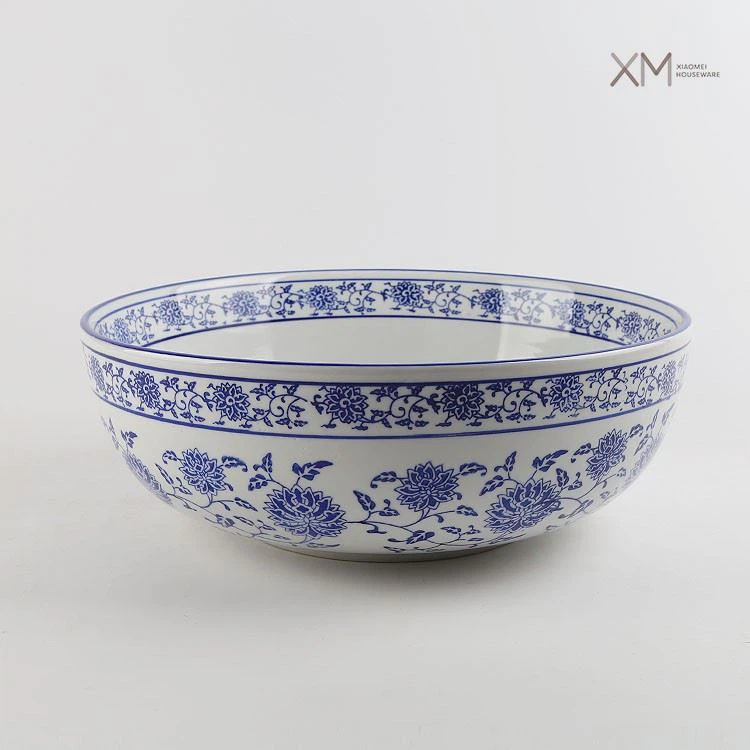
One popular type of decoration is the underglaze color. Take a look at this Vintage Floral 11.5 Inch Salad Ceramic Bowl Underglaze Colour Blue And White Porcelain. The blue and white floral design is a classic example of how beautiful underglaze decoration can be. Whether it's a large or small bowl, the underglaze color adds a touch of elegance.
Firing
The firing process is the final and most critical step in making porcelain bowls. Firing transforms the raw clay into hard, durable porcelain.
Large bowls require more careful firing. They take longer to heat up and cool down because of their size. If the temperature changes too quickly, the bowl can crack or warp. We usually fire large bowls at a slightly lower temperature and for a longer time to ensure even heating and cooling.
Small bowls can be fired more quickly. They heat up and cool down faster, so the firing time is shorter. However, we still need to be careful with the temperature to avoid any issues.
Quality Control
Quality control is important for both large and small white porcelain bowls. For large bowls, we check for cracks, warping, and uneven thickness. Since they're larger, any defects are more noticeable and can affect the functionality of the bowl.
Small bowls are also inspected carefully. We look for small chips, uneven glazing, or any other imperfections. Even though they're small, these defects can still impact the overall quality and appearance of the bowl.
Conclusion
So, as you can see, there are definitely some differences in the production process of large and small white porcelain bowls. From material selection to firing, each step has its own unique challenges and considerations depending on the size of the bowl.
If you're in the market for White Porcelain Bowl or Vintage Porcelain Bowl, whether it's a large centerpiece or a set of small decorative bowls, I'm here to help. I've got years of experience in the porcelain business, and I can provide you with high - quality products. If you're interested in purchasing, feel free to reach out for a procurement discussion. I'm always happy to chat about your needs and find the perfect porcelain bowls for you.
References
- "The Art of Porcelain Making." Traditional Ceramics Journal.
- "Porcelain Manufacturing Processes: A Comprehensive Guide." Industrial Ceramics Press.